

Blog


As efforts toward energy efficiency and decarbonization accelerate, many factories and data centers that rely on cooling processes are facing challenges related to aging chillers and rising operating costs. Even facilities where equipment renewal was once considered a long-term issue may now require reassessment from the perspectives of energy efficiency, lifecycle cost, and operational reliability. A chiller is not merely a cooling device. It is a critical infrastructure component that directly affects production quality, operational stability, and a company’s overall energy costs. For this reason, the choice of cooling method during equipment renewal can have a significant impact on future operating costs and the success of long-term decarbonization strategies. The two most common cooling methods are air-cooled chillers and water-cooled chillers. While both systems transfer heat using refrigerant, their heat rejection methods and system configurations differ, resulting in different suitability depending on application and operating conditions. Understanding the characteristics of both air-cooled and water-cooled systems is essential—not simply for comparison, but for accurately defining cooling requirements before system design begins. This article outlines the key characteristics of each system and provides guidance on how to evaluate cooling requirements, while also introducing how Mitsubishi Heavy Industries Thermal Systems (MTH) approaches cooling system engineering.
What Is an Air-Cooled Chiller? A Flexible and Versatile Cooling Solution
An air-cooled chiller rejects heat directly to the ambient air. Because it does not require cooling towers or cooling water pumps, it is typically installed outdoors.
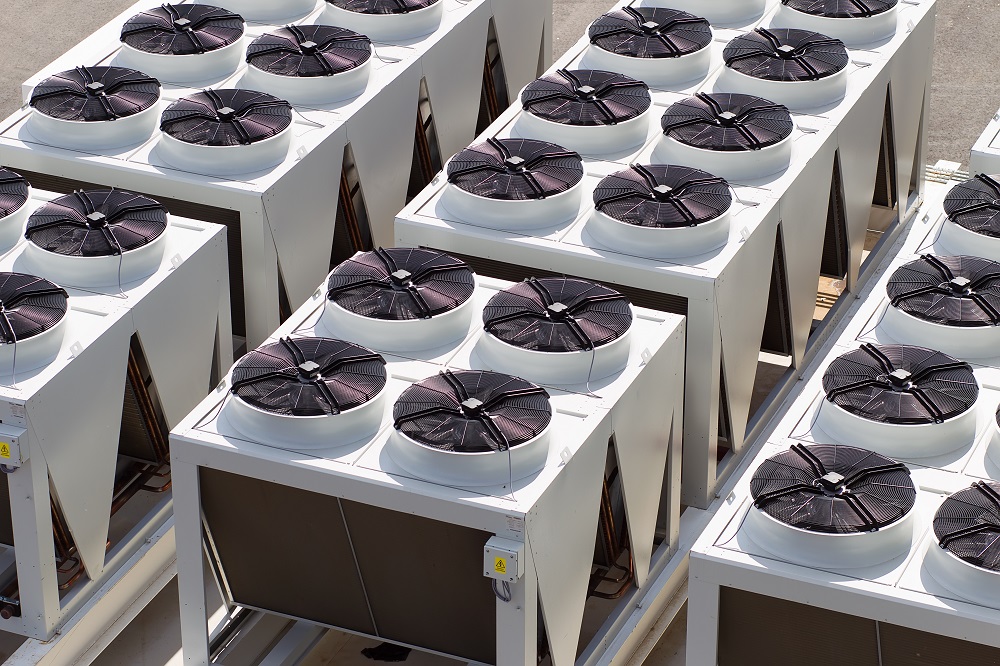
Image:Air-cooled chillers installed outdoors
Its relatively simple structure and minimal piping requirements allow for flexible installation, making it well suited for replacement projects or capacity expansion.
Key Features and Advantages
- No cooling tower or cooling water system required, resulting in a simple system configuration
- Suitable for sites with limited installation space
- In cooler seasons, natural cooling effects (free cooling) may be utilized
- Limited maintenance scope, enabling easier routine inspections
- No need for cooling water treatment, reducing operational burden
Air-cooled chillers are commonly adopted in facilities where securing cooling water is difficult or where cooling tower installation is constrained. Their compact footprint and short construction period also make them ideal for retrofit projects and installation in existing buildings.
Considerations and Design Measures
Because air-cooled chillers are installed outdoors, their performance and durability are more susceptible to ambient conditions such as temperature, humidity, wind, dust, and rainfall. To ensure stable long-term operation, the following considerations are essential:
- Capacity design that accounts for local climate conditions
- Protective measures against dust, rain, wind, and solar radiation
- Sufficient maintenance space for inspection and cleaning
Key Point:
What Is a Water-Cooled Chiller?High-Efficiency Cooling for Large-Scale Applications
A water-cooled chiller (Especially Centrifugal Type) rejects heat via cooling water. The system includes a cooling tower, pumps, piping, and water treatment equipment. Water-cooled chillers are available in several compressor types, including screw, scroll, and centrifugal (turbo). Among these, centrifugal chillers, which MTH primarily offers, are widely adopted in large facilities due to their high efficiency and suitability for large-capacity operation. They are commonly used in industrial plants, large commercial buildings, and data centers where stable, continuous cooling is required.
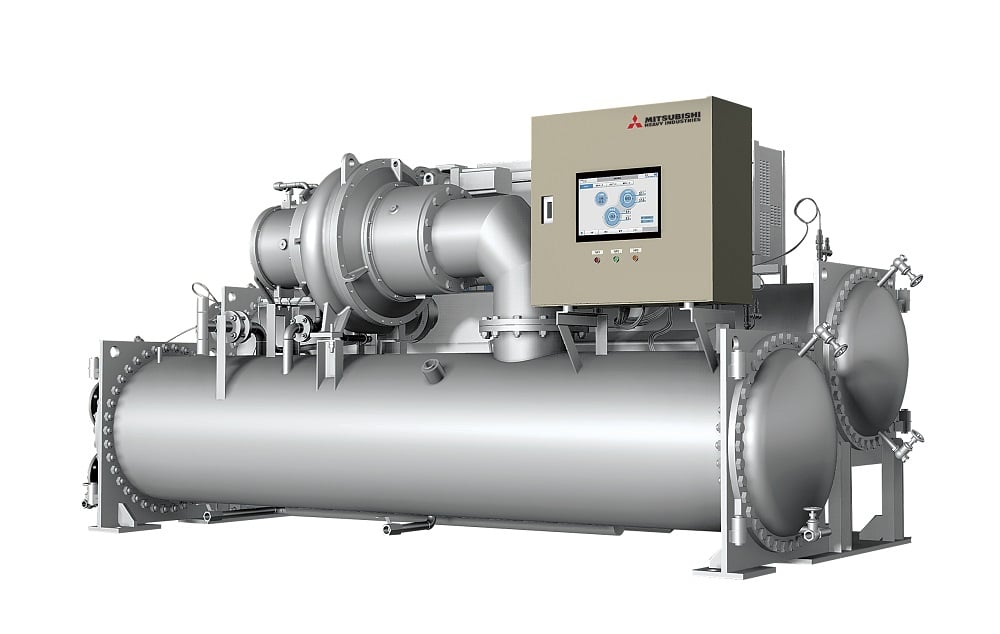
Image : Centrifugal chiller
Key Features and Advantages of Centrifugal Chillers
- Stable cooling water temperatures enable consistently high energy efficiency throughout the year
- Suitable for large cooling capacities and long operating hours
- Indoor installation reduces the impact of outdoor environmental conditions
- Low noise and vibration, meeting requirements for noise-sensitive facilities
- Optimized partial-load operation through inverter control and multi-unit configuration While water-cooled systems require higher initial investment and more complex configurations, they often provide advantages in terms of operational efficiency and lifecycle cost (LCC) over the long term.
Considerations and Design Measures
Compared to air-cooled systems, water-cooled chillers involve more auxiliary equipment, including cooling towers, pumps, piping, and water treatment systems. Adequate installation space and a well-planned maintenance framework are therefore essential. In addition, insufficient water quality management may lead to scaling or corrosion, which can degrade performance and shorten equipment life. A structured maintenance and water treatment plan is indispensable to sustain system performance.
Key Point:
Air-Cooled vs. Water-Cooled Chillers:Key Comparison Points
| Item | Air-Cooled Chiller | Water-Cooled (Centrifugal) Chiller |
|---|---|---|
| Initial Cost | Lower | Higher |
| Energy Efficiency | Varies with ambient conditions | High and stable |
| System Configuration | Simple | Requires cooling tower and water system |
| Maintenance | Simplified inspection scope, easier routine maintenance | Comprehensive inspections and preventive maintenance |
| Environmental Impact | Affected by outdoor conditions | Stable indoor operation |
| Typical Application Scale | Small to medium | Medium to large (factories, data centers) |
Defining Cooling Requirements Using Three Key Axes
There is no single “correct” answer when selecting a chiller. What matters most is defining cooling requirements based on site-specific conditions.
- Available installation space and feasibility of cooling towers
- Outdoor environmental conditions such as temperature, humidity, dust, and rainfall→ Air-cooled systems are often suitable for smaller or space-constrained sites, while water-cooled systems are advantageous for large-scale facilities requiring stable operation.
- Operating hours, load fluctuations, and seasonal variations→ As operating hours increase and load profiles become heavier or more stable, the efficiency advantages of water-cooled systems become more pronounced.
- Balance between initial investment and operating costs
- Alignment with energy-saving and decarbonization strategies → From a long-term perspective, water-cooled systems often offer superior CO₂ reduction and lifecycle cost optimization.
MTH’s Approach: Engineering-Based Consultation, Not Product Selection
Mitsubishi Heavy Industries Thermal Systems (MTH) offers both air-cooled and water-cooled chiller solutions in Japan, while overseas it maintains a framework to design and propose optimal cooling systems based on application requirements, system scale, and local environmental conditions. By analyzing operating data, load characteristics, and future operational plans, MTH supports customers in translating cooling needs into optimized system designs. Consultation typically starts with understanding cooling loads, operating patterns, and long-term energy objectives—before discussing specific equipment. The optimal chiller system is not simply selected—it is designed. MTH works with customers as an engineering partner, supporting cooling system design that balances efficiency, decarbonization, and long-term operational reliability.
RELATED CONTENTS


- Tags
- Thermal systems

Mitsubishi Heavy Industries Thermal Systems, as one of the core subsidiaries of Mitsubishi Heavy Industries group, offers thermal technologies and solutions.